Sunday, April 10, 2011

The Story of Chittorgarh

The history of Chittor is one of the most stirring chapters in Indian history for it was there that the flower of Rajput chivalry sprang to life and the immense stretch of its sacred walls and ruined palaces relate the saga of innumerable sieges and heroism which has almost become a myth now.
Chittorgarh was one of the most fiercely contested seats of power in India. With its formidable fortifications, Bappa Rawal, the legendary founder of the Sisodia dynasty, received Chittor in the middle of the eighth century, as part of the last Solanki princess's dowry. It crowns a seven-mile- long hill, covering 700 acres (280 hectares), with its fortifications, temples, towers and palaces.

From the eighth to the 16th century, Bappa Rawal's descendants ruled over an important kingdom called Mewar stretching from Gujarat to Ajmer. But during these eight centuries the seemingly impregnable Chittor was surrounded, overrun, and sacked three times.

In 1303 Allauddin khilji, Sultan of Delhi, intrigued by tales of the matchless beauty of Padmini, Rani of Chittor, of her wit and charm, decided to verify this himself. His armies surrounded Chittor, and the sultan sent a message to Rana Rattan Singh, Padmini's husband, to say that he would spare the city if he could meet its famous queen. The compromise finally reached was that the sultan could look upon Padmini's reflection if he came unarmed into the fort. Accordingly, the sultan went up the hill and glimpsed a reflection of the beautiful Padmini standing by a lotus pool. He thanked his host who courteously escorted Allauddin down to the outer gate-where the sultan's men waited in ambush to take the rana hostage.

There was consternation in Chittor until Padmini devised a plan. A messenger informed the sultan that the rani would come to him. Dozens of curtained palanquins set off down the hill, each carried by six humble bearers. Once inside the Sultan's camp, four well-armed Rajput warriors leaped out of each palanquin and each lowly palanquin bearer drew a sword.In the ensuing battle, Rana Rattan Singh was rescued-but 7,000 Rajput warriors died. The sultan now attacked Chittor with renewed vigor. Having lost 7,000 of its best warriors, Chittor could not hold out. Surrender was unthinkable. The rani and her entire entourage of women, the wives of generals and soldiers, sent their children into hiding with loyal retainers. They then dressed their wedding fine , slid their farewells, and singing ancient hymns, boldly entered the mahal and performed jauhar.

The men, watching with expressionless faces, then donned saffron robes, smeared the holy ashes of their women on their foreheads, flung open the gates of the fort and thundered down the hill into the enemy ranks, to fight to the death.The second sack or shake (sacrifice) of Chittor, by which Rajputs still swear when pledging their word, occurred in 1535, when Sultan Bahadur Shan Of Gujarat attacked the fort.

Rana Kumbha

Rana Kumbha (1433-68) was a versatile man a brilliant, poet and musician. He built mewar upto a position of assailable military strength building a chain of thirty forts that girdled the kingdom But, perhaps more important was a patron of the arts to rival Lorenzo de Medici, and he made Chittorgarh a dazzling cultural center whose fame spread right across Hindustan.

Rana Sanga

Rana Sanga

Rana Sanga (reigned 1509-27) was a warrior and a man of great chivalry and honor reign was marked by a series of continual battles, in course of which he is said to have lost one arm and had been crippled in one leg and received eighty-four wounds on his body. The last of his battles was again Mughal invader, Babur, in 1527. Deserted by one ofgenerals, Rana Sanga was wounded in the battle and shortly after.


Maharana Pratap


Over the next half-century, most other Rajput rulers allowed themselves to be wooed the Mughals; Mewar alone held out. In 1567 Emperor Akbar decided to teach it a lesson: he attacked Chittorgarh razed it to the ground. Five years later Maharana Pratap (reigned 1572-97) came to rule Mewar - a king without a capital. He continued to defy Akbar, and in 1576, confronted the imperial armies at Haldighati.

The battle ended in a stalemate and Maharana Pratap and his followers withdrew to the craggy hills of Mewar, from where they continued to harrass the Mughals through guerilla warfare for the next twenty years. Maharana Pratap made his descendants vow that they would not sleep on beds, nor live in palaces, nor eat off metal utensils, until Chittorgarh had been regained.In fact, right into the 20th century the maharanas of Mewar continued to place a leaf platter under their regular utensils and a reed mat under their beds in symbolic continuance of this vow.

Maharana Pratap
 

Rani Padmini

Rani Padmini


In 1303 Allauddin khilji, Sultan of Delhi, intrigued by tales of the matchless beauty of Padmini, Rani of Chittor, of her wit and charm, decided to verify this himself. His armies surrounded Chittor, and the sultan sent a message to Rana Rattan Singh, Padmini's husband, to say that he would spare the city if he could meet its famous queen. The compromise finally reached was that the sultan could look upon Padmini's reflection if he came unarmed into the fort. Accordingly, the sultan went up the hill and glimpsed a reflection of the beautiful Padmini standing by a lotus pool. He thanked his host who courteously escorted Allauddin down to the outer gate-
where the sultan's men waited in ambush to take the rana hostage.

 
There was consternation in Chittor until Padmini devised a plan. A messenger informed the sultan that the rani would come to him. Sultan's camp, four well-armed Rajput warriors leaped out of each palanquin and each lowly palanquin bearer drew a sword.In the ensuing battle, Rana Rattan Singh was rescued-but 7,000 Rajput warriors died. The sultan now attacked Chittor with renewed vigor. Having lost 7,000 of its best warriors, Chittor could not hold out. Surrender was unthinkable. The rani and her entire entourage of women, the wives of generals and soldiers, sent their children into hiding with loyal retainers. They then dressed their wedding fine , slid their farewells, and singing ancient hymns, boldly entered the mahal and performed jauhar.


Chittorgarh And Jainism

Chittorgarh is ancient center of Jain tradition. Here are few facts about Chittor:
  1. Chittor is adjacent to the ancient city of Madhyamika. The Jain inscriptions at Mathura from the Kushana period (1-3rd cent) mention a "Majjhimilla" branch of the "Kottiya" gana, indicating that it was a major Jain center.
  2. The famous Acharya Haribhadra Suri (6th cent) was born in Chittor and wrote "Dhurtopakhyana" there.
  3. There was a scholar Elacharya at Chittor from whom Vira-senacharya (9th cent) learned the ancient Shat-khandagama and Kashayapahuda. Vira-senacharya later the famous "Dhavala" and "Jayadhavala" on the basis of these books.
  4. Chittor was the residence of Jinavallabha who propagated the Vidhimarga in the 12th cent. In the 15-17th century, it was the seat of a Bhattaraka.
You might also like:

The Buddhist Councils

First Buddhist Council
 http://www.bodhgayatourism.com/photo/rajgir3.jpg

The First Council, as it is known to Buddhist history, took place at Rajgir, the capital of the Magadha kingdom. The Buddha's most important disciples were asked to recite his teachings from memory.

http://t0.gstatic.com/images?q=tbn:ANd9GcSxeAAHCULPTE8L9SpknA16G9f_RteEOFrI_iBp0pTP1UY2pth9

The first to recite was Ananda, the Buddha's cousin, attendant and constant companion for more than 30 years. Demonstrating impressive powers of memorization, he recited not only everything he had heard, but the place in which each discourse was given. Other monks were then asked to confirm Ananda's recollection.

http://www.cultural-china.com/chinaWH/images/exbig_images/979b135377ef4bf0ba30748b44a59eef.jpg

It was also at this council that the Buddha's teachings were divided into three categories or "baskets" (pitaka): discourses, discipline and higher knowledge. The Tripitaka that was formed at this meeting is the same canon used by Buddhists today.
  • Held soon after the death of the Buddha
  • around 400 BCE
  • Presided by monk Mahakasyapa
  • Held by Magadha king Ajatasatru in Rajagriha
  • Objective was to preserve the Buddha’s sayings (suttas) and monastic rules (Vinaya)
  • According to some sources, the Abhidhamma Pitaka, or its matika, was also included.
  • Also the Sangha made the unanimous decision to keep all the rules of the Vinaya, even the lesser and minor rules.
  • Tradition holds that the Council was held in a hall erected by Ajatasattu outside the Sattaparnaguha Cave
Detailed accounts of the council can be found in the Khandhaka sections of the canonical Vinayas.
According to this record the incident which prompted the Elder Mahakassapa to call this meeting was his hearing a disparaging remark about the strict rule of life for monks. The monk Subhadda, who had ordained late in life, upon hearing that the Buddha had expired, voiced his resentment at having to abide by all the rules for monks laid down by the Buddha. Many monks lamented the passing of the Buddha and were deeply grieved but Subhadda spoke up to show happiness and relief that Buddha was gone.


Second   Buddhist Council
http://www.thisismyanmar.com/nibbana/images/ymba55.jpg

The group who stayed called themselves the Elders (Thera in Pali). They felt they were in keeping with the original spirit of the Buddha's teachings. The other group, the Great Community (Mahasanghika in Sanskrit), interpreted Buddha's teachings more liberally, but in a way that they felt was more true to his intentions. These two groups would eventually evolve into Theravada and Mahayana Buddhism.

(4th century BCE)
  • Held about 100 years after the Buddha’s demise
  • Held at Vaisali under the presidentship of Sabakami, convened by King Kalasoka
  • Objective was to settle a debate on certain practices of Buddhist monks, esp. in western India
Although it is unclear exactly what happened at this council, we do know that it resulted in a split in the Buddhist community. A large group of monks were either expelled or left by choice because they did not agree with the other group's interpretations of the Buddha's teachings.

Within 200 years of the Buddha's death, there were 18 schools of Buddhism in India. This is perhaps not surprising, given that the Buddha taught in a slightly different way for each situation, was averse to setting down doctrine and never wrote anything himself. Moreover, Buddhism had now spread to places with different languages and customs, and therefore different perspectives on the dharma.


Third   Buddhist Council


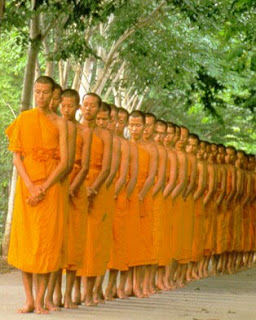
The reason for convening the Third Buddhist Council is reported to have been to rid the Sangha of corruption and bogus monks who held heretical views.
 https://blogger.googleusercontent.com/img/b/R29vZ2xl/AVvXsEhipXWukZlyl1V8P7MIpIaL0HAENOVp58SLZdB0T_jp_URXwja1U1EjJwoGwbsmryUldnw2yDrSX0hFQEosbbSJlPMj8fCnq9-peTd-R-Aenf6NvVOqHA8mAUG4jKaHBoWEKkx18xrLsKQ/s400/sangha1.jpg

Disputes on points of doctrine lead to further schisms, spawning the Sarvastivadin and Vibhajjavadin sects. The Abhidhamma Pitaka is recited at the Council, along with additional sections of the Khuddaka Nikaya. The modern Pali Tipitaka is now essentially complete, although some scholars have suggested that at least two parts of the extant Canon — the Parivara in the Vinaya, and the Apadana in the Sutta — may date from a later period.
(250 BCE)
  • Held at Pataliputra under the patronage of Asoka
  • Chief monk was Mogaliputta Tissa
  • Sent Buddhist missionaries to other countries
  • Objective was to purify the Buddhist movement from opportunistic factions
  • Origin of Theravada school


Fourth   Buddhist Council

http://c.photoshelter.com/img-get/I0000rBzWaYk9p1U/s

Fourth Buddhist Council is the name of two separate Buddhist council meetings. The first one was held in the 1st century BC, in Sri Lanka. In this fourth Buddhist council the Theravadin Pali Canon was for the first time committed to writing, on palm leaves. The second one was held by the Sarvastivada school, in Kashmir around the 1st century AD.
(1st century BCE or CE)
  • Possibly held under Theravada school in Tambapanni (Sri Lanka) in the 1st century BCE
  • Committed the Pali Canon to writing
  • Another possibly held under Saravastivada tradition, convened by Kanishka around 100 CE in Kashmir under the leadership of monk Vasumitra
  • Kanishka’s council translated Abhidharna texts from Prakrit to Sanskrit


Fifth   Buddhist Council


·         The Fifth Buddhist council  took place in Mandalay, Burma (Myanmar) in 1871 AD in the reign of King Mindon.
·          The chief objective of this meeting was to recite all the teachings of the Buddha according to the Theravada Pali Canon and examine them in minute detail to see if any of them had been altered, distorted or dropped. .
·         It was presided over by three Elders, the Venerable Mahathera Jagarabhivamsa, the Venerable Narindabhidhaja, and the Venerable Mahathera Sumangalasami in the company of 2,400 monks.
·         Their joint Dhamma recitation lasted five months.


Sixth   Buddhist Council

·         The Sixth Buddhist Council was a general council of Theravada Buddhism, held in a specially built cave and pagoda complex at Kaba Aye Pagoda in Yangon, Burma.
·          The council was attended by 2,500 monastics from eight Theravada Buddhist countries.
·         The Council lasted from Vesak 1954 to Vesak 1956, its completion coinciding with the traditional 2,500th anniversary the Buddha's Parinibbāna. In the tradition of past Buddhist councils, a major purpose of the Sixth Council was to preserve the Buddha's teachings and practices as understood in the Theravada tradition.
·         Over the two-year period, monks (sangīti-kāraka) from different countries recited from their existing redaction of the Pali Canon and the associated post-canonical literature.
·          As a result, the Council synthesized a new redaction of the Pali texts ultimately transcribed into several native scripts.


http://www.buddhanet.net/e-learning/history/images/tipitaka_chart.gif
You might also like:

Vijaynagar Kingdom- points to remember

  • Yusuf Adil Shah was killed by KrishnaDeva Raya(KDR) in the Battle of Kovilkonda
  • KDR was known as Andhra Bhoja whereas Allasani Peddana was known as Andhra Kavita Pitamaha
  • Tenali Rama who wrote Panduranga Mahamattya, adorned the court of KDR
  • Tirumalamma was a famous poetess in the court of Achyuta Deva
  • During Virupaksha II Orissa became a part of Vijaynagar empire for the first time
  • Amuktamalyada written by KDR in Telegu was a book on polity
  • Siddhya was the tax collected in cash
  • Bukka sent an embassy to China(Ming dynasty).He adopted the title Vedamarga Pratisthapaka
  • Besabaga was the sale of human.Nicolo Conti talks in detail about it
  • Shalabhoga educational grant
  • Devaraya II wrote Mahanataka Sudhanidhi in sanskrit.His court was visited by Abdur Razzak
  • Battle of Talikota or the Battle Rakshasha Taggadi was fought on the bank of river Krishna
  • Devaraya I included Turkish soldiers in his army.His court was visited by Nicolo Conti.
  • The Military Dept was known as Khandachara and the revenue Dept as Athvane
  • Nuniz came during KDR's rule
  • Nikitin talks about the financial dualism prevailing in the country
  • Pattanaswamy was the head of Traders' Associations
  • Bhandarabadha was the crown land
  • Lola Lakshmidhara wrote "Saraswati Vilasa"
  • Rayasam was Royal decree
  • Anegundi was the initial capital of Vijayngar empire
  • KDR abolished marriage tax and patronised "Ashtadiggaja"
  • Kalyanamandapa was the ornated pillar pavillions in the temples
  • Barbers were exempted from professional taxes
  • Harihara II captured Belgaum and Goa and attacked SriLanka after which he took the title"Maharajadhiraja"
  • KDR gave permission to Albequerque to built a fort at Bhatkal
  • Harihara and Bukka initially served under PrataprudraDeva II of Kakatiya dynasty
  • Marava were the fishermen
  • Srirangam inscription belongs to KDR

Mughal India and Delhi Sultanat

MUGHAL INDIA
  • Mubarak Khan whose father was killed in the battle of Macchiwara killed Bairam Khan
  • When Hemu captured Delhi Tardi Khan was the governor there
  • The first mention of Tauhid i Ilahi was in Dabistan i Mazahib by Mohsin Fani
  • Diwan i Tan was the official who was in charge of cash salary
  • Increase in the sawar of the mansabdars during emergency was known as mashruta
  • The reserved Armed force was known as Tabinan
  • Total land revenue figures of a village was known as taqsimat
  • Akbar reimposed Jeziyah in 1575 and revoked it in 1580
  • Although the Kangra mission of Jahangir in 1620 was led by Vikramjit Baghela, a Hindu,Jahangir called it a Jihaad
  • Khasrau was captured by Jahangir's forces at Bhairowal
  • Jahangir punished Sufi saint Nizaam Thaneswari
  • In 1543 Sher Shah organized a campaign against Multan to set it free from Biloch tribe
  • Malik Jiwan a Baluchi leader betrayed Dara and helped Aurangzeb to capture him
  • In 1668 Aurangzeb prohibited court dancing,1669 he ordered destruction of temples and in 1679, he imposed Jeziyah
  • Shaikh Sarmad a Sufi saint and associate of Dara was punished by aurangzeb
  • Peter Mundy gives a vivid account of the famine of 1630-32
  • After returning from Deccan Aurangzeb was made the governor of Gujarat in 1644
  • Shah Jahan's army met with Guru Hargovind's army at Kartarpur in 1631. There the guru's force was supported by Painda Khan
  • Shah Jahan started giving land on contractual basis or the Ijara system
  • Some books written by Guru Govind Singh- Nam Mela Puran,Shastar nam puran, Mangal Prakash,Akal ustat,Ukat Vilas,Krishna Avatar,Ram AvatarChandi charittar,Chandi di var,Pakhayama charittar.His autobiography was vaichittar nataka.His letters to Aurangzeb-Zafarnamah
  • Mir Jumla was originally a minister of Abdullah Kutub Shah of Golkunda
  • The Amins collected Jeziyah under Aurangzeb
  • In 1654 Dara was conferred the title sultan buland iqbal
  • Punishing Jujhair Singh Bundella was the first official assignment of Aurangzeb
  • Jahan Ara wrote under the pen name Makhfi
  • Tribute of the autonomous kings was known as peshkash
  • Ashrafi was a gold coin
  • Potugese brought tobacco in India in 16th century
  • Shah rukhi was a silver coin
  • Mir Fathulla Sirazi was a famous scientist
  • Shah Jahan introduced the post of Amin
  • Nahr i Bahist was the canal dug by Shah Jahan
  • Amalguzars gave taqqavi loans
  • Muqaddam and Patwari were the village headmen
  • Capt Avery was a notorious pirate and his prized catch was Ganj i Swai, a ship of Aurangzeb
  • Abdullah Sultan Puri was conferred the title Makhdum ul Mulk by Akbar
  • Ibrahim Adil Shah wrote Kitaab i Nauras.He was popular as Abla baba and also Jagat Guru
  • Maasir i Alamgiri written by Mustaid Khan
  • Faizi translated Lilavati,Sarhandi translated Atharvaveda,Todarmal translated Bhagvata Puarana,Shahbandi translated Rajtarangini and Badaoni translated Ramayana
  • Akbar gave Hari Vijay Suri the title Jagat Guru and Shah Jahan gave Jagannath the title Kavipriya
  • Shalima Begum invented Rose itr
  • Bishandas was sent to Persia by Jahangir to get a portrait of the ruler
  • Man Kautahal was a collection of Man Singh of Gwalior's famous musical works
  • Rajaram looted Akbar's tomb in 1688
  • When Babur was ill some nobles wanted to install Mehdi Khwaja on the throne
  • Guru Amar Das took vigorous steps to abolish sati
  • Guru Hargovind built Akal Takht
DELHI SULTANAT

  • Iltutmish belonged to the Ilbari tribe
  • Nizam ul Mulk Junaidi came into prominence during Iltutmish
  • Fakhruddin was the chief kotwal of Delhi under Balban
  • Apart from Mohd Bin Tughlak Nasir udduin Mahmood too was a great caligraphist
  • Imaduddiin conspired against Balban in 1353-54
  • Balban separated army from civil administration and created arz i mamalik
  • Hauz shamshi was built by Iltutmish
  • Abdullah the grandson of Hlaku Khan invaded India during Jalaluddin Khalji
  • Malik Qabul was the shuhna i mandi under Alauddin
  • Ulugh Khan a mongol accepted Islam under Jalaluddin
  • "Soveregntyis not conferred upon everyone but it is placed on the elect"-Mohd Bin Tughladk
  • Amirana i sadbah revolted in Malwa, Gujaraat and lDaulatabad
  • Mailik Ghazi Shahna wdas the chief aArchitect under Feroz
  • Diwan i amirat was in charge of public works
  • Amir Sirzi wrote Faulad ul faud
  • In Nuh Sipihr Amir Khsrau showers praise on India
  • Zia Naakshbandi translated Sukha Saptati to Tutinamah
  • Dhrupad was Indian in origin
  • Ghuiyat ul Muniya by Malik Shamshuddin Abu Raja was the earliest Persian work on Indian music
  • Niamatnamah was a book on cooking
  • Adilabad and Jahapanah were built by Mohd Bin Tughlak
  • Lodhis borrowed enamelled tiles from Persia
  • Spindle was Indian in origin
  • Dhenkili was a water lifting device
  • Alauddin took the title Yamini Khilafat
  • Bahlol Lodhi invaded Jaunpur in 1484
  • Timur invaded India during Nasiruddin Mahmud Tughlak
  • Jalaluddin's original name was Mlik Firuz
  • Alauddin Shah of Bengal started Satya Pir movement.He patronized Maladhar Basu who translated Bhagvat Purana into Bengali and wrote Srikrishnavijya
  • Jainal Abedin borrowed paper making technology from Samarkand and he was the first sultan to abolish Jeziyah
  • Sikander Shah was known as Aurangzeb of Kashmir
  • In 1320 Mongol leader Dulucha invaded Kashmir
  • Jainal Abedin patronized Jonaraja and Sivaraja
  • Before Islam arrived Kashmir was a seat of Shaivism
  • Malik Mohd Jaisi lived in Jaunpur
  • Jainal Abedin built Jaina lake.He was known as Bud Shah
  • Mahmud Beghara sacked Dwarka as it harbored pirates and he also captured Girnar and Champaner
  • Ahmad Shah built Ahmedabad in 1414
  • Zafar Khan founded Gujarat
  • Ghiyasuddin Iyaz Khalji of Bengal transferred his capital to Lakhnauti from Devkot
  • Kampilendra founded Gajapati dynasty
  • Shungmung was a popular ruler of Assam

What is PL 480 Programme?

What is PL 480 Programme?- the full name is Public Law 480 also known as "Food for Peace" is a funding avenue by which US food can be used for Overseas Aid.

- the full name = Public Law 480 is " Agricultural Trade Development Assistence Act", signed on Law on july 10, 1954 by President Dwight D Eisenhower.

- in 1961, president John F.Kennedy renamed it as "Food For Peace".

- it has 4 parts:
Title 1
Title 2
Title 3
Title 5

- PURPOSE OF PL 480 PROGRAMME :
  • combat world hunger & malnutrition
  • promote sustainable development including agricultural development.
  • expand international trade
  • develop & expand market for US Agriculture commodities & products.
  • foster private enterprise & democratic participation.
EXPLANATION OF THE ABOVE TITLES:
TITLE 1 IS TRADE & DEVELOPMENT ASSISTENCE
(managed by USDA):
- it allows concessional sales of agriculture products to friendly developing nations, either by government to government or government to private activities.

- concessional terms are very favourable it can be long term credit upto 30 years, with no minimum repayment for 10 years, grace period for payment of principle upto 5 years at low interest of 2-4%.

- programme is flexible & allow facilitate collaboration with international bodies such as world bank in support of development programme.

PRIORITIES GIVEN ARE:
  • countries with little foreign exchange
  • countries with food security problems
  • program with alleviate poverty as the core.
  • countries with agriculture developmental needs.
  • receipent's countries must also demostrate potential to become commercial markets for US Agri Products.
TITLE 2 IS EMERGENCY & DEVELOPMENT ASSISTENCE PROGRAM (managed by USAID) :

- main use is -- allow donation of US agri products meet humanitarian food needs, emergency & non-emergency food aid activities support broader USAID.

RECIPANTS CAN BE ANY OF FOLLOWING :
  • PVO = Private Voluntary Organisation
  • NGO = Non Government Organisation
  • IO = International Organisation & World Food Programme.
for non-emergency aid title 2 can be often to be in support :
- development food aid (non-emergency)
- health & nutrition program
- agriculture (food-for-work, food-for-agriculture)
- educational programe
- humanitarian relief
- vulenrable population
- micro enterprise development

TITLE 3 IS FOOD FOR DEVELOPMENT
(manage by USAID) :
- it is a government to government grants to least developed countries.
- aim at addressing food & nutrition problem, countries most in need of food to enhance long term food security.

PROGRAMMAS ARE:
  • privatisation of food market
  • attract poor children to school
  • address chromic food short fall.
  • infrastructure development - Roads.
TITLE 5 IS FARMER TO FARMER (managed by USAID) :
- established in 1986, re-authorised by 1996 Farm Bill Act.
- it is not a food program, but a short term technical assistance by linking american volunter farmer with developing countries farmers.

- program was established aimed mainly at the NIS of ex Soviet Union.

What is Currency swap?

What is Currency swap ?
A swap that involves the exchange of principal and interest in one currency for the same in another currency. It is considered to be a foreign exchange transaction and is not required by law to be shown on the balance sheet.
A Currency swap (or cross Currency swap) is a foreign exchange agreement between two parties to exchange a given amount of one currency for another and, after a specified period of time, to give back the original amounts swapped.

In a Currency swap, the holder of an unwanted currency exchanges that currency for an equivalent amount of another currency to improve the market liquidity of a currency owned or to obtain bank financing at a lower rate.

National Savings Certificate (NSC)

National Savings Certificate, popularly known as NSC, is a time-tested tax saving instrument that combines adequate returns with high safety.

National Savings Certificate can be purchased by the following:
  • An adult in his own name or on behalf of a minor,
  • A minor,
  • A trust
  • Two adults jointly,
  • Hindu Undivided Family
National Savings Certificates are available in the denominations of Rs. 100, Rs 500, Rs. 1000, Rs. 5000, & Rs. 10,000. There is no maximum limit on the purchase of the certificates.

Period of maturity of a certificate is six years. Presently, maturity value of a certificate of Rs. 100 denomination is Rs. 160.10. Maturity value of a certificate of any other denomination is at proportionate rate. Premature encashment of the certificate is not permissible except at a discount in the case of death of the holder(s), forfeiture by a pledgee and when ordered by a court of law.

Interest accrued on the certificates every year is liable to income tax but deemed to have been reinvested. Income Tax rebate is available on the amount invested and interest accruing under Section 88 of Income Tax Act, as amended from time to time. Income tax relief is also available on the interest earned as per limits fixed vide section 80L of Income Tax, as amended from time to time.